AI & Emerging Tech
Establishing Foundations for an AI-Enabled Design Practice

Context
Following the announcement of the sale of Boeing Digital Aviation Solutions, the UX organization was restructured, and I assumed leadership of the DesignOps team. At the same time, AI was rapidly reshaping design and software workflows, but adoption within the organization was fragmented and driven primarily by individual experimentation.
A small AI Design Working Group existed, but participation was limited, and its focus on static documentation was quickly becoming obsolete given the pace of change.
Leadership recognized AI’s potential impact, but there was no coordinated effort to help designers adopt emerging tools, integrate them into workflows, or influence how AI would shape future products.
I took ownership of the initiative to begin establishing a more structured, designer-led approach.
Objective
The goal was to establish the foundation for a designer-led AI practice that would help the UX organization explore emerging tools and prepare for AI-enabled workflows.
Specifically, we aimed to:
Establish safe pathways for designers to experiment with emerging AI tools within a highly security-sensitive enterprise environment
Explore applications in prototyping, design systems, research, and analytics
Ensure design had a voice in enterprise AI adoption alongside engineering and product
Build organizational readiness for AI-driven product development
Approach
I reorganized the existing working group and began establishing the structure, team, and charter needed to support hands-on experimentation.
1. Shifting the Focus from Documentation to Experimentation
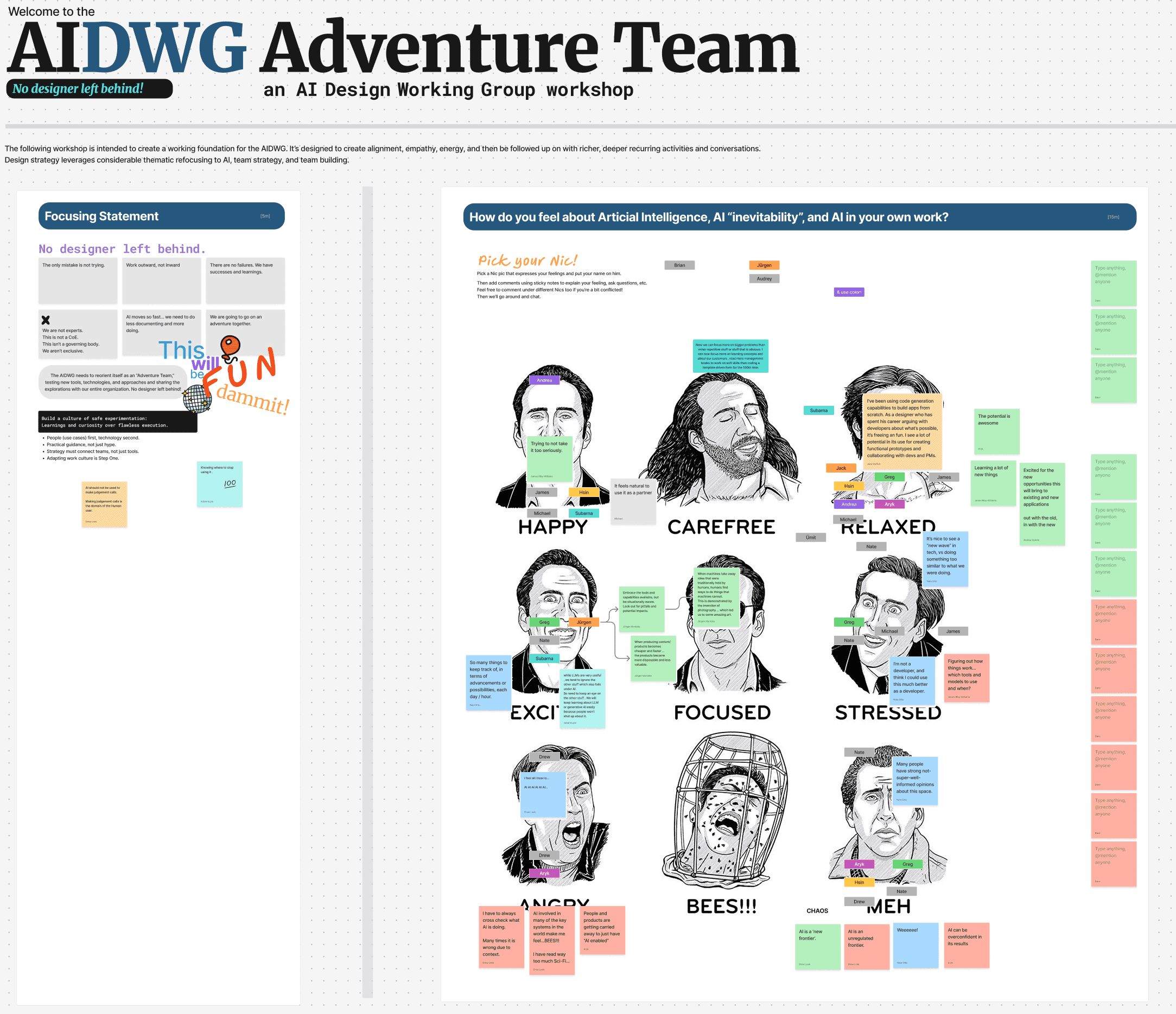
Rather than producing static guidance, I reframed the group as an experimental “Adventure Team,” focused on learning through direct use of AI tools.
The guiding principle was “no designer left behind”—ensuring designers could actively learn and adapt as AI began changing workflows.
The intended focus included:
Hands-on experimentation with emerging tools
Rapid prototyping and workflow exploration
Sharing findings with the broader UX organization
2. Recruiting a Cross-Functional, Global Team
I recruited participants from across the newly forming Jeppesen ForeFlight organization, including:
Product designers from multiple portfolios
UX engineers
The enterprise design system architect working on MCP integration
The Creative Director with deep AI expertise
A CX analytics specialist
Designers from ForeFlight teams
This created a distributed group spanning North America, Europe, and India, bringing together perspectives across design, engineering, and analytics.
3. Planning the Team Charter and Operating Model
I partnered with our design facilitator to plan a workshop to help the group define its mission, priorities, and operating model.
The intent was to explore areas such as:
AI-assisted prototyping using tools like Figma Make
AI-supported UI development using GitHub Copilot and the Atmosphere design system
Applications of AI in research, Voice-of-Customer analysis, and analytics
Opportunities to accelerate legacy product modernization
This approach was designed to ensure the initiative was practitioner-driven and aligned with real product and operational needs.
4. Aligning with Existing AI and Design System Exploration
The initiative connected with parallel experimentation already underway, including efforts to:
Generate front-end code aligned with design system standards
Accelerate prototyping and concept validation
Explore AI-assisted modernization of legacy enterprise interfaces
My goal was to ensure these efforts were coordinated and that design remained actively involved.
Outcomes
The initiative was interrupted by organizational restructuring and layoffs during the charter workshop, before the team could establish its operating model or begin sustained experimentation.
Despite this, the effort:
Established initial organizational alignment around designer-led AI exploration
Brought together a cross-functional, global group focused on AI readiness
Positioned DesignOps as the natural organizational home for AI enablement
My Role
I led the effort to reorganize and relaunch the AI Design Working Group, including:
Defining the vision and scope for AI exploration within UX
Recruiting a cross-functional, international team
Planning the team charter workshop and operating model
Aligning the initiative with design system and DesignOps strategy
This work demonstrated proactive leadership in preparing a global UX organization for emerging AI-driven workflows, even as broader organizational restructuring halted the initiative.
14
Team members recruited
3
Global regions represented
5
Enterprise AI use cases identified